
EdCity has already published a series of articles introducing “values education”, and parents will likely be familiar with this concept. However, if one wishes to cultivate positive values in children more effectively, volunteering presents an excellent starting point. For younger children and adolescents, volunteering offers the finest experiential learning. Through it, they grasp the spirit of empathy and compassion, while more readily developing a sense of social responsibility. So let us now explore how to put this into practice!
Step #1: Explaining Motivation Behind Volunteering to Children to Transition from Self-Motivation to Positive Values
(This image is only available in Chinese)
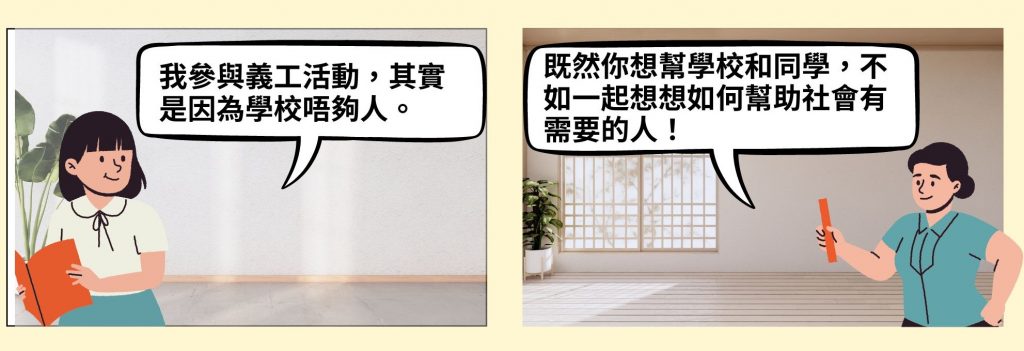
Many parents would agree that participating in voluntary work with their children is a meaningful family activity. Yet whilst encouraging greater involvement, have parents clearly explained the motivations behind participation to their children?
In truth, when first encountering volunteering, different children have different motivations. Some participate out of curiosity, others to make friends. At this stage, parents need not set overly ambitious goals for their children. Whatever their initial motivation, starting to volunteer is a positive beginning worthy of parental affirmation and encouragement. Nevertheless, parents can guide their children to transform their purpose:
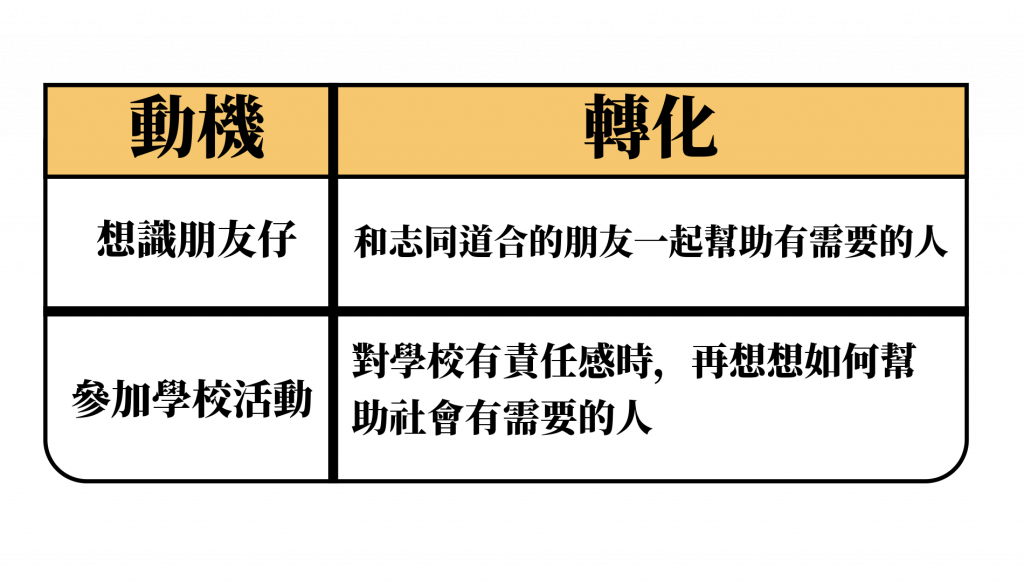
(This image is only available in Chinese)
Therefore, regardless of the reason behind a child's involvement in volunteering, it is a positive start and a valuable opportunity to cultivate a sense of responsibility and empathy.
Step #2: Consider the Target Audience for Volunteering and Cultivate Empathy
At this stage, parents may wonder how their child should select whom to serve. To address this, EdCity has interviewed Ling Wai-hang, a registered social worker and university lecturer. He advised that parents should base their choices on the child's age and personality. For more introverted children, starting with family-based volunteering activities is advisable—such as beach clean-ups or gift-wrapping sessions at care homes. Once children become accustomed to volunteering, parents can then introduce them to voluntary work involving a wider range of beneficiaries. This not only fosters empathy but also hones social skills. Numerous community initiatives offer direct engagement with vulnerable groups. Through personal interaction and dialogue, children develop a deeper understanding that life is rarely straightforward.
Indeed, diverse volunteering experiences allow children to explore varied roles and responsibilities. This cultivates positive values while strengthening multiple competencies. Therefore, when encouraging children to engage in voluntary service, parents can assign them diverse roles, including but not limited to participant, assistant, organiser, and initiator. By assuming different responsibilities, pupils can acquire varied skills and knowledge while developing leadership abilities, interpersonal communication skills, and teamwork spirit.
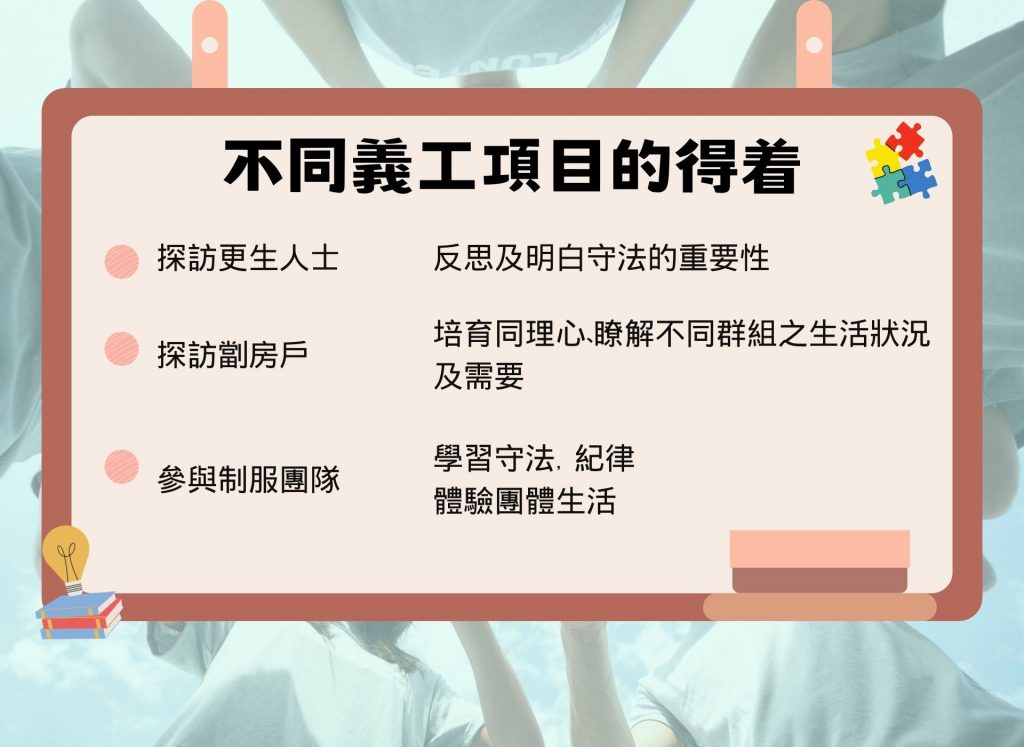
(This image is only available in Chinese)
Step #3: Fostering Reflection and Encouraging Ongoing Participation
Volunteering undoubtedly cultivates students' sense of responsibility, yet parents often harbour concerns—such as worrying that charitable work might distract their children and affect their studies. However, contemporary society emphasises holistic development, so encouraging sustained volunteer participation allows meaningful activities to become an integral part of a child's life.
Nevertheless, if a child is navigating significant life transitions such as examinations or changing schools, parents should adjust participation levels accordingly. Quantity and duration need not be excessive; more is not necessarily better. Quality is fundamentally more important.
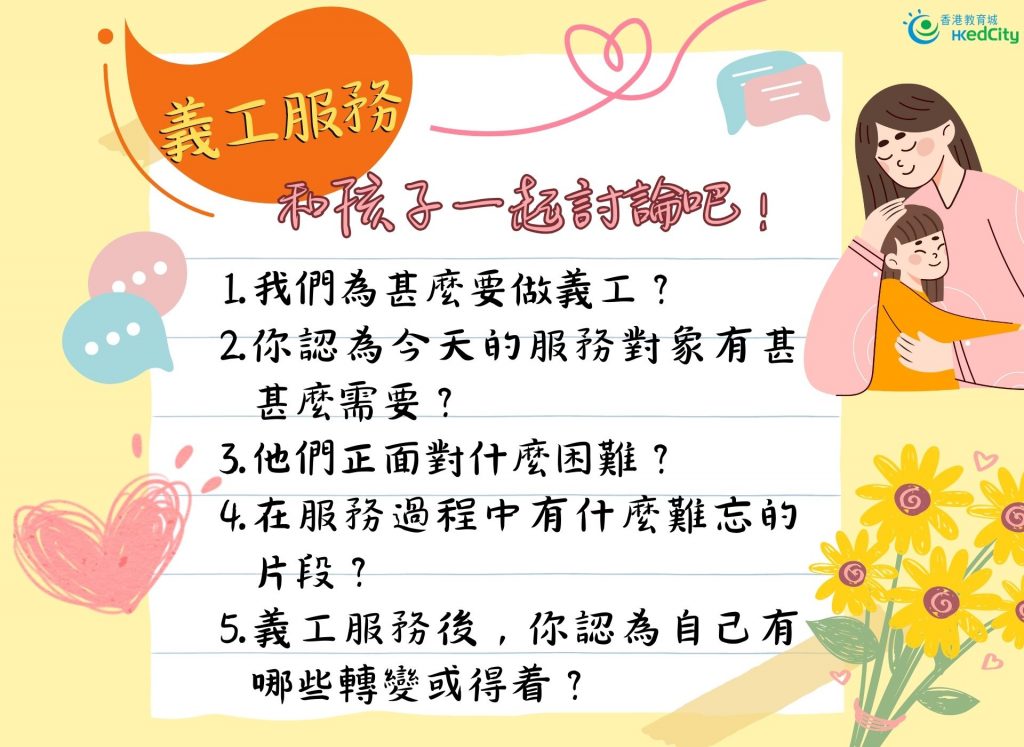
In summary, while volunteering is certainly worthy of encouragement for its potential to cultivate positive values in children, it is even more crucial for parents to accompany their children, sharing, explaining, and discussing experiences together. If parents wish to use volunteering as a vehicle for positive values education, the following guiding questions may be useful for discussion with their children.
 (This image is only available in Chinese)