
‘It's not my fault, Mum and Dad forgot...’
‘My helper forgot to remind me...’
Have you ever heard your child say these words? Today's youngsters constantly learn new things yet sometimes neglect to examine their own behaviour and conduct. They may even resort to excuses, failing to fulfil their duties while refusing to shoulder responsibility. Can such children truly grow into individuals who contribute meaningfully to society? Therefore, teaching children to take responsibility is a crucial task for every parent. Though termed ‘teaching,’ values education cannot rely solely on a ‘lecture’ approach. Parents should first examine their own behaviour, demonstrate their own sense of responsibility, and then accompany their children in learning and growing together.
The Spirit of Responsibility Comes from Within
For many, the term “responsibility” is not unfamiliar, yet do we truly grasp its essence? To embody responsibility requires fulfilling three levels: first, diligently discharging one's own duties without negligence; second, having fulfilled one's own duties, stepping forward without hesitation to shoulder social responsibilities, extending one's own standards to others and becoming a conscientious global citizen; Finally, responsibility also demands courage – the courage to confront one's mistakes, to acknowledge them, and to correct them.
Thus, we realise that while the word ‘responsibility’ can be easily said than done, to truly learning to embody it is by no means simple. So how should parents nurture their children to understand the spirit of responsibility?
Starting With Parental Responsibility

(This image is only available in Chinese)
To teach children about responsibility, parents must first ask themselves: ‘Do I embody a sense of responsibility?’ When we enrol our children in language classes or piano lessons, are we merely paying the fees, or do we actively monitor their progress and accompany them in their learning? When our children practise day and night for a performance, are we watching television nearby, or browsing websites?
“The first step in teaching responsibility is for parents to shoulder the duty of education and companionship themselves.”
Regarding common blind spots in parental education, Principal Chau of Sham Tseng Catholic Primary School shared valuable insights with EdCity. She emphasised that parental responsibility extends beyond merely handling administrative tasks – signing registers or returning forms does not fulfil one's duty. True involvement requires active participation in accompanying children through their experiences and growth. ‘Only when parents demonstrate their own sense of responsibility can children genuinely understand that everyone in society has their own duties. It is then possible to guide them in contemplating how to become responsible individuals.’
Principal Chau also cited a more common example: packing school bags. Sometimes pupils forget that packing their bags is their responsibility. When homework is missing, they often tell teachers: ‘Mum and Dad forgot to remind me.’ Shifting their own responsibility onto their parents. At such times, parents can use encouraging words to help children learn responsibility: ‘Look! Mummy and Daddy have taken care of their responsibilities. I believe you understand better what you need to do!’ ‘You can certainly do it better than Mummy and Daddy, can't you?’
Even if the child makes a mistake and faces consequences, this remains a perfectly normal part of the learning journey. Parents can accompany their children through this, teaching them to own up to errors and courageously make amends. This process is precisely what one must experience to learn responsibility.
Extending One's Own Standards to Others
In Chinese culture, we often cite that moral maxim: ‘Cultivate oneself, regulate one's family, govern the state, and bring peace to the world.’ This indicates that positive values must expand from the inner self outward to foster a more harmonious and prosperous society. Thus, responsibility must likewise extend from the individual to the societal level.
This may sound abstract and distant, yet the first step is remarkably simple: starting with household chores. Parents can encourage pupils to first take care of themselves, fulfilling their duties as students and children. Subsequently, they might ask their offspring: ‘What can you do to help the family?’ This approach encourages children to look after themselves while proactively assisting with household tasks, simultaneously learning to cherish and care for household items.
At school, parents may suggest that children, after looking after themselves, try to assist classmates in need and proactively lend a hand when teachers require support. In this way, children's sense of responsibility can gradually expand outward, making families, schools, and society better places.
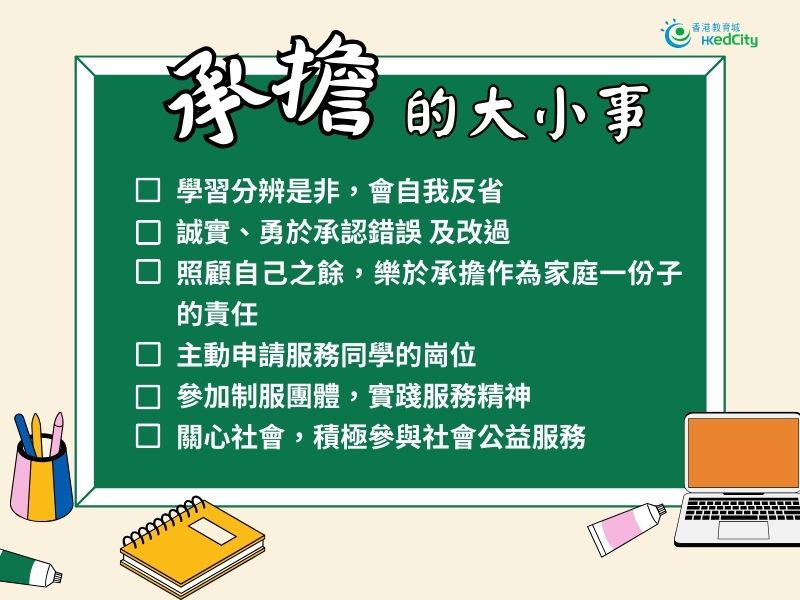
(This image is only available in Chinese)
Why should we teach our children responsibility? Because when children understand responsibility, it signifies they know how to care for themselves. Moreover, the courage to correct mistakes equips them to adapt to the future, helping them navigate an ever-changing social environment. We hope parents will lead by example, working alongside their children to cultivate a spirit of responsibility, adapting together and creating a better life.