

Consider yourself as a parent bringing your children to a carnival, with the youngster full of ambition determined to take home a large stuffed toy. Fortunate enough, one of the stall games involved tossing four balls into a large plastic barrel placed at an angle to win the grand prize of a large stuffed toy.
At first, your child carefully tossed the balls, but they all bounced back out of the barrel. Then, nearby players succeeded in landing their balls inside the barrel, prompting cheers. Nonetheless, your child still wishes to try again, to which you allowed, and even encouraged your child to first observe how the successful players threw their balls. So, your child earnestly studied the angle of the throw, the force applied, and the landing spot of the balls, meticulously analysing every detail.
Of course, games always involve an element of luck; even with two hundred percent effort, winning the grand prize is never guaranteed. After several attempts, your child ultimately came home empty-handed. Seeing your child's dejected expression, how would you, as a parent, respond? How might you console them while also acknowledging their effort?

(This image is only available in Chinese)
Setting Goals Using the SMART Principle
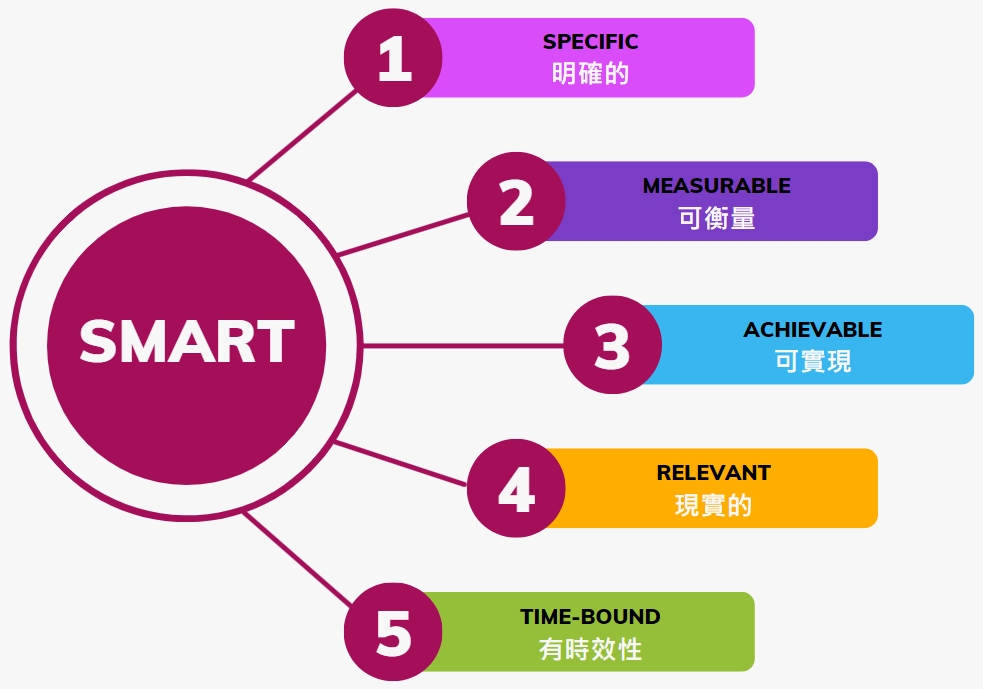
Like the scenario above, numerous goals and setbacks will arise throughout a child's development. Rather than devising solutions each time a setback occurs, it is wiser to adopt a more astute and proactive approach to goal-setting. Establishing objectives using the SMART principle can help stimulate a child's interest and motivation. What does this entail? Let’s apply the SMART principle to the scenario above.
- Specific: The stall game's display, laden with grand prizes, exemplifies a highly specific goal. Applied to daily life, this means setting concrete quantities, precise dates, or detailed actionsteps;
- Measurable: In the game, prizes are awarded based on the number of balls scored. Similarly, quantifiable metrics can be designed across various life domains to track progress andachievements;
- Achievable: Whilst scoring in the plastic bucketisn't easy, success is attainable through observing others and repeated practice. The key lies in discovering the right technique and maintaining focus;
- Relevant: Just as the ball-throwing game presents a challenge, it is far from impossible. Note that overly ambitious goals may lead to frustration, whilst excessively simple ones lack meaningfulchallenge;
- Time-bound: The game stipulates only four attempts per round, not a cumulative total of four successful shots. When setting otherobjectives, replacing the number of attempts with a specific date or timeframe can heighten urgency.
Setting Goals Together with Your Children
At the start of the new year, as parents, have you set any goals for yourselves? Setting goals isn't just for your own sake, but for your children too. Parents should set goals together with their children, helping them understand that the journey of learning is not a solitary one. Parents can also lead by example, becoming fellow goal-setters alongside their children, striving together towards their respective goals and enjoying the process. Resolve now to cultivate a positive mindset in your children, filling their approach to learning with joy and enthusiasm.